
What Is Depreciation Recapture? Equipment vs. Real Estate
By Josh Heine, Content Strategist at Simple Mining
Published November 10, 2026
Depreciation recapture is the tax rule for the part of a gain that comes from depreciation on business property you sell. Depreciation lowers your taxable income while you own an asset. Recapture settles that benefit when you sell the asset for more than its adjusted basis.
Equipment and real estate follow different recapture rules, which matters for anyone who owns depreciable alternative investments such as mining equipment or rental property.
This guide explains how the IRS rules work and isn't tax advice, so talk to a tax professional about your situation.
On this page · 15 sections
- What Is Depreciation Recapture?
- How Does Depreciation Recapture Work?
- What Is the Depreciation Recapture Tax Rate?
- What Are Section 1245 and Section 1250 Property?
- How Do You Calculate Depreciation Recapture?
- Depreciation Recapture Example
- What Happens to Depreciation When You Sell a Bitcoin Miner?
- What Happens If You Sell a Fully Depreciated Asset?
- Does Selling at a Loss Avoid Depreciation Recapture?
- How Do Bonus Depreciation and Section 179 Affect Recapture?
- Can You Avoid Depreciation Recapture?
- Does a 1031 Exchange Avoid Depreciation Recapture?
- How Does the IRS Track Depreciation Recapture?
- FAQs About Depreciation Recapture
- Plan for the Full Life of Your Mining Hardware
Key Takeaways
- Depreciation recapture taxes the part of a gain that comes from depreciation allowed or allowable on business property.
- Equipment such as a Bitcoin miner is Section 1245 property, and its recapture is ordinary income taxed at rates up to 37%.
- Buildings are Section 1250 property, and unrecaptured Section 1250 gain is taxed at a maximum 25% rate.
- On a sale, recapture applies only to gain above adjusted basis, so a sale at a loss has none. Section 179 recapture can still apply without a sale when business use drops to 50% or less.
- Faster deductions such as 100% bonus depreciation lower basis faster, which means an early sale can recapture more.
- A 1031 exchange can defer recapture on real property. Equipment such as a Bitcoin miner has not qualified since 2018.
What Is Depreciation Recapture?
Depreciation recapture is the tax treatment of the part of a gain that comes from depreciation you deducted on business property. When you sell depreciable personal property (Section 1245 property) at a gain, the gain is ordinary income up to the depreciation you took. Put another way, the ordinary part is the lesser of the depreciation allowed or allowable and your total gain.
Each year's depreciation deduction lowers your taxable income. A sale above adjusted basis shows the asset kept more value than the deductions assumed, and recapture taxes that difference.
How Does Depreciation Recapture Work?
Depreciation recapture works in three moves: depreciation lowers the asset's basis, a sale above that adjusted basis creates a gain, and the Code splits the gain by where it came from.
First, basis drops. You must reduce basis by the depreciation you were entitled to take, even if you did not deduct it. The IRS calls this "allowed or allowable."
Second, the sale sets the gain. Your gain is the amount realized minus your adjusted basis. If you sell for less than adjusted basis, you have a loss and there is no recapture.
Third, the gain splits. The part up to the depreciation taken gets recapture treatment. For equipment held more than one year, any gain above the original cost is Section 1231 gain. Under Section 1231, a net gain for the year on business property held more than one year is treated as long-term capital gain, and a net loss is an ordinary loss. A net Section 1231 gain is ordinary income to the extent of non-recaptured net Section 1231 losses from the prior five years.
Section 1245 recapture has no holding period test. If you held the property one year or less, the whole gain is ordinary and goes in Part II of Form 4797. The Part III recapture computation is for property held more than one year.
What Is the Depreciation Recapture Tax Rate?
The depreciation recapture tax rate depends on the property: recapture on equipment is ordinary income taxed at rates up to 37%, while unrecaptured Section 1250 gain on real estate is taxed at a maximum 25% rate. Gain beyond the depreciation can qualify for long-term capital gains rates of 0%, 15%, or 20%. Long-term means you held the asset more than one year.
| Portion of gain | Applies to | How it's taxed |
|---|---|---|
| Section 1245 recapture | Equipment and other depreciable personal property, such as a Bitcoin miner | Ordinary income rates, up to 37% |
| Unrecaptured Section 1250 gain | Buildings and other depreciable real property | Maximum 25% rate |
| Remaining gain | Either type, held more than one year | Long-term capital gains rates of 0%, 15%, or 20% |
IRS Topic 409 sets out the 25% maximum for unrecaptured Section 1250 gain and the long-term capital gains rates. The top ordinary income rate stays 37% because the 2025 law (Pub. L. 119-21) made the post-2017 rate table permanent.
True Section 1250 ordinary recapture applies only to "additional depreciation." That means depreciation above what straight line would have produced, or all of the depreciation if the building was held one year or less. Buildings placed in service after 1986 are depreciated straight line under MACRS, so in most cases there is no Section 1250 ordinary recapture on them. A special depreciation allowance on Section 1250 property can count as additional depreciation.
What Are Section 1245 and Section 1250 Property?
Section 1245 property includes depreciable personal property, such as equipment, machinery, and computers. Section 1250 property is depreciable real property that is not Section 1245 property, such as buildings. Land is not depreciable.
Publication 946 gives the reason: land does not wear out, become obsolete, or get used up. The part of a rental's price allocated to land never depreciates and never creates recapture.
Computers and peripheral equipment are 5-year MACRS property. Residential rental buildings are depreciated over 27.5 years and nonresidential real property over 39 years, straight line with a mid-month convention.
A Bitcoin miner is equipment, which makes it personal property. Its recapture follows Section 1245.
Cost segregation splits a building's cost into parts, moving some components into shorter-life Section 1245 property for faster depreciation. Those components are then subject to Section 1245 recapture when sold.
| Equipment | Residential rental real estate | |
|---|---|---|
| Code section | Section 1245 | Section 1250 |
| Recovery period | 5 years for computers and peripheral equipment | 27.5 years (39 years for nonresidential real property) |
| Method | MACRS half-year convention (20% in year one, 32% in year two); 100% bonus depreciation for qualified property | Straight line with a mid-month convention |
| What's recaptured | Depreciation up to the gain | Depreciation up to the gain, as unrecaptured Section 1250 gain |
| Top rate on the recaptured part | 37% (ordinary income) | 25% maximum |
| Like-kind exchange | Not eligible since 2018 | Eligible under Section 1031, which defers the gain |
How Do You Calculate Depreciation Recapture?
To calculate depreciation recapture, find your gain on the sale and compare it with the depreciation allowed or allowable. The smaller of the two is the recapture amount.
- Start with your cost basis. For real estate, that includes the land, but only the building's share is depreciated.
- Subtract the depreciation allowed or allowable to get your adjusted basis.
- Figure the gain: amount realized minus adjusted basis.
- Find the recapture: the lesser of the gain or the depreciation.
- Apply the rates: ordinary rates up to 37% for Section 1245 recapture, a maximum 25% for unrecaptured Section 1250 gain, and 0%, 15%, or 20% for the rest.
Depreciation Recapture Example
A depreciation recapture example shows the split: a Bitcoin miner's gain is ordinary income up to the depreciation taken, while a rental's gain divides into unrecaptured Section 1250 gain and long-term capital gain. All numbers below are hypothetical and rounded. Selling costs, state tax, and the net investment income tax are left out.
Depreciation Recapture on a Bitcoin Miner
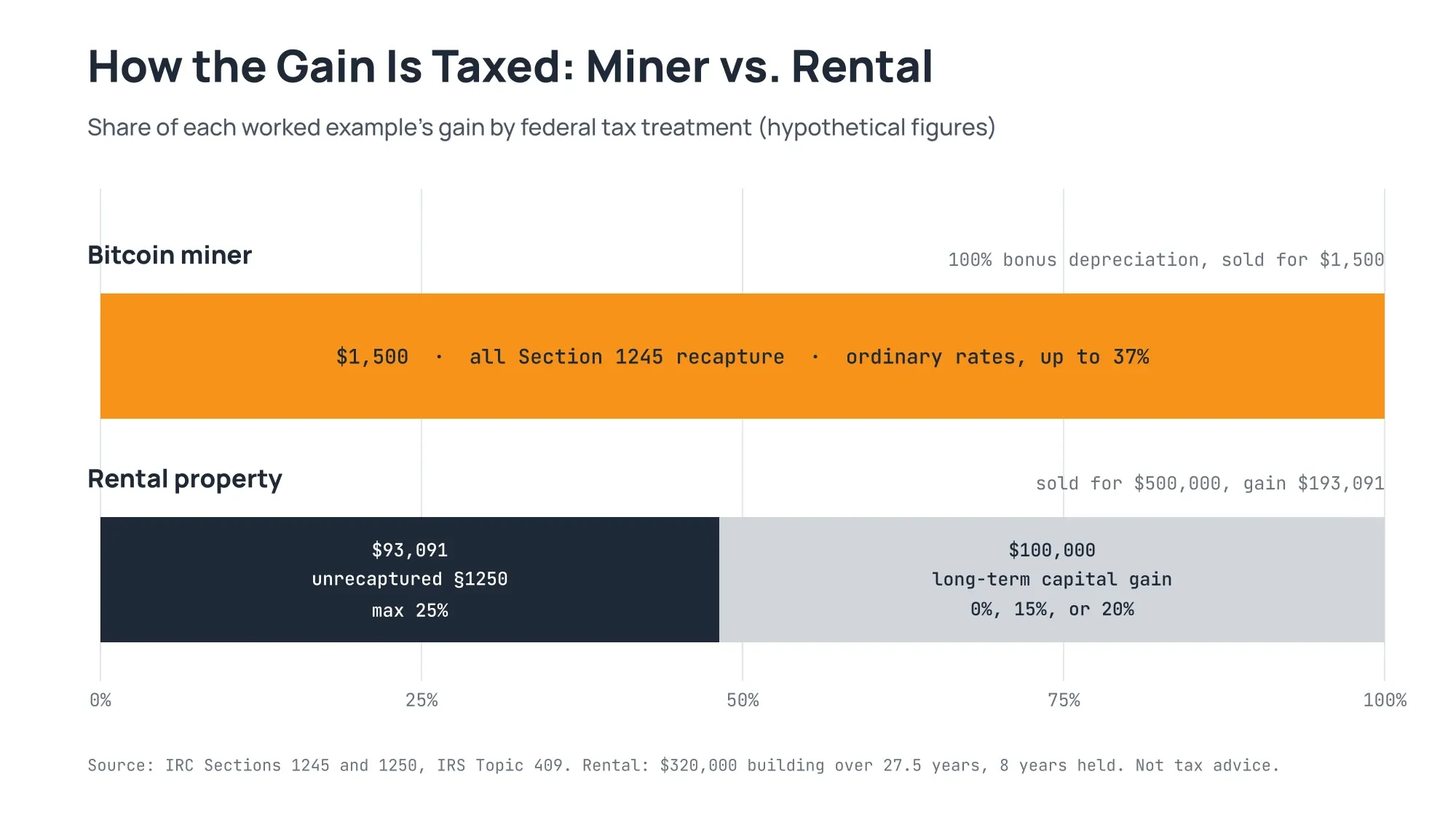
You buy a Bitcoin miner for $5,000 and take 100% bonus depreciation in year one, which drops your adjusted basis to $0. You sell it in year three for $1,500. Section 1245 ordinary income is the lesser of the depreciation taken ($5,000) or the gain ($1,500), so the full $1,500 is ordinary income.
Now assume the same miner sits on a regular 5-year MACRS schedule with no bonus and no Section 179. Depreciation is 20% in year one ($1,000) and 32% in year two ($1,600). Because the sale happens in year three, the half-year convention allows half of that year's 19.2% rate, or 9.6% ($480). Total depreciation is $3,080, which leaves a basis of $1,920.
| Step | 100% bonus depreciation | Regular 5-year MACRS |
|---|---|---|
| Cost | $5,000 | $5,000 |
| Depreciation taken | $5,000 (year one) | $3,080 ($1,000 + $1,600 + $480) |
| Adjusted basis | $0 | $1,920 |
| Sale price in year three | $1,500 | $1,500 |
| Gain or loss | $1,500 gain | $420 loss |
| Section 1245 recapture | $1,500 ordinary income, up to 37% | None |
None of the bonus version's gain is capital gain. The regular version's $420 loss has no recapture. It is a Section 1231 loss, and it is ordinary if the year's net Section 1231 result is a loss.
Depreciation Recapture on Rental Property
A rental property sale follows the Section 1250 rules. You buy a rental for $400,000, with $320,000 allocated to the building and $80,000 to land. Annual depreciation is $320,000 / 27.5, or about $11,636 a year. The example uses eight full years and simplifies the mid-month convention in the first and last years.
| Step | Amount |
|---|---|
| Purchase price ($320,000 building, $80,000 land) | $400,000 |
| Annual depreciation ($320,000 / 27.5) | $11,636 |
| Depreciation over 8 years | $93,091 |
| Adjusted basis | $306,909 |
| Sale price | $500,000 |
| Total gain | $193,091 |
| Section 1250 ordinary recapture | $0 |
| Unrecaptured Section 1250 gain, up to 25% | $93,091 |
| Long-term capital gain, 0%, 15%, or 20% | $100,000 |
Section 1250 ordinary recapture is $0 because the building was depreciated straight line. The $93,091 of unrecaptured Section 1250 gain is taxed at a maximum 25% rate. Depreciation is what places rental buildings among common tax-advantaged investments, and this split is how the Code settles it at the sale.
What Happens to Depreciation When You Sell a Bitcoin Miner?
When you sell a Bitcoin miner at a gain, the gain is Section 1245 ordinary income up to the depreciation you took. Any gain above the miner's original cost is Section 1231 gain if you held the miner more than one year. A sale below adjusted basis is a loss with no recapture.
A trade-in counts as a disposition too. Since 2018, like-kind exchanges under Section 1031 apply only to real property, so trading in a miner for a newer model does not qualify.
When bonus depreciation or Section 179 is taken, the first-year deduction sets most of the basis reduction that a later sale can recapture. Our guide to bonus depreciation for Bitcoin miners walks through that deduction in full.
Simple Mining clients can list used miners to other clients through the Simple Mining Client Marketplace, where buyers submit an offer. A sale there is a disposition like any other, and the used ASIC miner marketplace article covers how a hosted client marketplace compares with other resale channels.
With Bitcoin miner hosting, the machine runs in our Iowa facilities. You own the hardware. Not cloud mining, not rented hashrate. The depreciation you take and the recapture on a later sale are both yours.
What Happens If You Sell a Fully Depreciated Asset?
An asset depreciated down to zero has an adjusted basis of zero, so the whole sale price is gain. For Section 1245 property, that gain is ordinary income up to the depreciation taken (the original cost). Any gain above original cost is Section 1231 gain if the asset was held more than one year.
The bonus depreciation miner in the example above is this case. Its basis is $0, it sells for $1,500, and all $1,500 is ordinary income.
Does Selling at a Loss Avoid Depreciation Recapture?
Yes, a sale for less than adjusted basis has no depreciation recapture. Recapture applies only to the amount by which the sale price exceeds adjusted basis, so a loss leaves nothing to recapture.
A loss on business property held more than one year is a Section 1231 loss. If your net Section 1231 result for the year is a loss, it is an ordinary loss.
Keep in mind that the test uses adjusted basis, not the price you paid. An asset can sell for far less than its cost and still produce a gain.
How Do Bonus Depreciation and Section 179 Affect Recapture?
Bonus depreciation and Section 179 move deductions into the first year, which lowers basis faster and means an early sale can recapture more. The 2025 law (One Big Beautiful Bill Act) made 100% bonus depreciation permanent for qualified property acquired after January 19, 2025. The IRS issued guidance in Notice 2026-11 (IR-2026-06, January 14, 2026).
Section 179 has a second recapture trigger that needs no sale. If business use of Section 179 property falls to 50% or less during its recovery period, you must recapture part of the Section 179 deduction. Listed property has a similar rule under Section 280F(b)(2).
Bonus depreciation is one of the ways to reduce taxable income with business equipment, and it shapes the tax on a later sale.
Can You Avoid Depreciation Recapture?
The Code provides a few ways recapture is deferred, shifted to someone else, or never triggered, and each has limits. The main rules cover like-kind exchanges, transfers at death, gifts, installment sales, the home sale exclusion, and involuntary conversions.
- Like-kind exchange: A like-kind exchange of real property defers the gain, including the depreciation, as the next section explains.
- Transfer at death: A transfer at death does not trigger depreciation recapture, and heirs take a basis equal to fair market value at the date of death. Section 1245(b)(2) provides the exclusion.
- Gift: A gift does not trigger recapture. The recipient takes the donor's basis, and the recapture potential carries over to the recipient because recapture counts depreciation taken by "any other person."
- Installment sale: The rule is that an installment sale does not defer ordinary income recapture. Section 1245 and Section 1250 ordinary income recapture is reported in the year of sale, even if you receive the payments later. Unrecaptured Section 1250 gain stays on the installment method and is taken into account before other capital gain in each payment.
- Home sale exclusion: The home sale exclusion does not cover the part of the gain equal to depreciation taken after May 6, 1997, for example on a home office or a rented period.
- Involuntary conversion: Section 1033 can defer the gain on property that is destroyed, stolen, or seized when you buy similar replacement property in time, as the FAQ below explains.
Which rule applies turns on the facts of each transfer.
Does a 1031 Exchange Avoid Depreciation Recapture?
A 1031 exchange defers depreciation recapture on real property, but it does not erase it. When you exchange a rental solely for like-kind real property, no gain is recognized, and the replacement property takes the old property's basis. The depreciation you took carries into the new property, and recapture applies when that property is sold in a taxable sale.
Cash or other property you receive in the exchange, often called boot, makes the gain taxable up to the money plus the fair market value of that other property. Under Section 1031, you must identify the replacement property within 45 days and receive it within 180 days, or by your tax return due date with extensions if that comes first.
Equipment does not qualify. Since 2018, Section 1031 applies only to real property, so trading in a Bitcoin miner for a newer model gets no like-kind deferral.
How Does the IRS Track Depreciation Recapture?
The IRS tracks depreciation recapture through two main forms: Form 4562 for depreciation and Form 4797 for the sale. Form 4562 reports depreciation on property placed in service during the year, the Section 179 election, special (bonus) depreciation, and listed property. Form 4797 Part III figures the depreciation recapture that is reported as ordinary income.
The Form 4797 instructions route property held one year or less to Part II instead. Recapture counts the depreciation allowed or allowable, so a year you skipped still reduces basis.
FAQs About Depreciation Recapture
Is depreciation recapture taxed as ordinary income?
Depreciation recapture is ordinary income only on equipment and other Section 1245 property, where it is taxed at rates up to 37%. On a building depreciated straight line, the depreciation part of the gain is unrecaptured Section 1250 gain, a type of long-term capital gain taxed at a maximum 25% rate. Section 1250 ordinary recapture applies only to additional depreciation, which a building depreciated straight line and held more than one year does not have.
Does depreciation recapture apply when you sell a partnership interest?
Yes, for the ordinary income part. Your share of the partnership's Section 1245 recapture and Section 1250 ordinary recapture is an "unrealized receivable" under Section 751, so that part of the sale price produces ordinary income. If you held the interest more than one year, your share of the partnership's unrecaptured Section 1250 gain is also taxed at a maximum 25% rate.
Does the net investment income tax apply to depreciation recapture?
The net investment income tax can apply to gains on property used in passive activities. It does not apply to gains on property held in a trade or business that is not passive (and not trading financial instruments or commodities). The tax is 3.8% of the lesser of your net investment income or the amount by which your modified adjusted gross income exceeds $200,000 for single or head of household filers, $250,000 for married filing jointly, or $125,000 for married filing separately.
How do repairs and improvements affect depreciation recapture?
Repairs and maintenance can be deducted in the year paid, so they add nothing to the depreciation a sale can recapture. Improvements such as betterments, restorations, and adaptations to a new use must be capitalized and depreciated unless a safe harbor election such as the de minimis safe harbor applies. That depreciation is subject to recapture.
What happens if you donate depreciated property?
If you donate depreciated business property to charity, the deduction is reduced by the amount that would have been ordinary income (including recapture) had you sold it at fair market value. Section 170(e) sets that rule.
What if equipment is destroyed or stolen?
If property is destroyed, stolen, or seized and you receive a payment for the loss, you can defer the gain under Section 1033 by buying similar replacement property within the replacement period, in most cases two years after the end of the first tax year in which you realize gain. Section 1245(b)(4) then limits recapture to the gain you must recognize plus the value of any replacement property that is not Section 1245 property.
Plan for the Full Life of Your Mining Hardware
Depreciation recapture is the sale-side half of the deduction you take on equipment: ordinary income on a miner, a 25% maximum on a building's depreciation, and capital gains rates on the rest. When you buy Bitcoin miners, the purchase starts a depreciation record that the sale will settle. The Bitcoin mining tax calculator estimates the bonus depreciation savings at the start of that record. Talk to a tax professional about how the purchase, the deductions, and a future sale fit your situation.