
How to Invest in Data Centers: Stocks, REITs, or Direct
By Josh Heine, Content Strategist at Simple Mining
Published October 22, 2026
How to invest in data centers comes down to a few routes: public REITs, operator and supplier stocks, ETFs, private funds, and direct ownership of sites or the hardware inside them. AI and cloud demand are driving a data center build-out, and power is the scarce input. Most routes trade liquidity for control, from shares you can sell in a day to sites that tie up capital for years. The key takeaway: match the route to your goal, whether that's income, growth, or owning a real asset.
On this page · 12 sections
- How Can You Invest in Data Centers?
- Are Data Centers a Good Investment?
- 7 Ways to Invest in Data Centers
- Stocks vs. REITs vs. Direct Ownership Compared
- Which Companies Are Data Center REITs?
- Is There a Data Center ETF?
- How to Invest in Data Center Real Estate
- Why Power Decides Which Data Centers Get Built
- How Bitcoin Miners Fit Into Data Center Investing
- Data Center Investment Risks to Watch
- FAQs About Investing in Data Centers
- Choose Your Data Center Investment Path
Key Takeaways
- You can invest in data centers through REITs, operator stocks, supplier stocks, ETFs, private funds and non-traded REITs, direct real estate, or hosted hardware.
- Most routes trade liquidity for control: public shares are easy to sell but give you no say, while direct sites tie up money for years and give you the most control.
- Power decides which data centers get built, and US data centers used about 4.4% of the country's electricity in 2023.
- Some data center ETFs hold cell tower companies too, so read the holdings before you assume pure data center exposure.
- Owning hosted hardware, such as a Bitcoin miner, gives you a real machine, but its revenue moves with Bitcoin's price, network difficulty, and hashprice.
How Can You Invest in Data Centers?
You can invest in data centers by owning shares of the companies that own, run, or supply them, by joining private funds, or by owning sites or hardware yourself. A data center is a building that houses servers along with the power, cooling, and network gear that keep them running. Data centers are part of digital infrastructure, the physical backbone of cloud and AI computing.
Every data center has four layers, and each route gives you exposure to one or more of them:
- Real estate: the land and buildings. REITs, private funds, and direct real estate deals give exposure here.
- Power and cooling: substations, backup power, and cooling systems. Supplier stocks and owners of power-rich sites sit here.
- Compute: the chips and servers. Operator stocks, AI cloud providers, and hosted hardware give exposure here.
- Connectivity: fiber and networking. Interconnection-focused REITs and networking suppliers sit here.
The largest tenants are often hyperscalers, the giant cloud companies such as Amazon, Microsoft, and Google. To invest in hyperscale data centers, you can own shares of a hyperscaler, where data centers are one part of a larger business, or of a REIT that leases space to cloud providers. Anyone asking how to invest in AI data centers faces the same four layers, because an AI data center is a data center built for dense, power-hungry chips.
Are Data Centers a Good Investment?
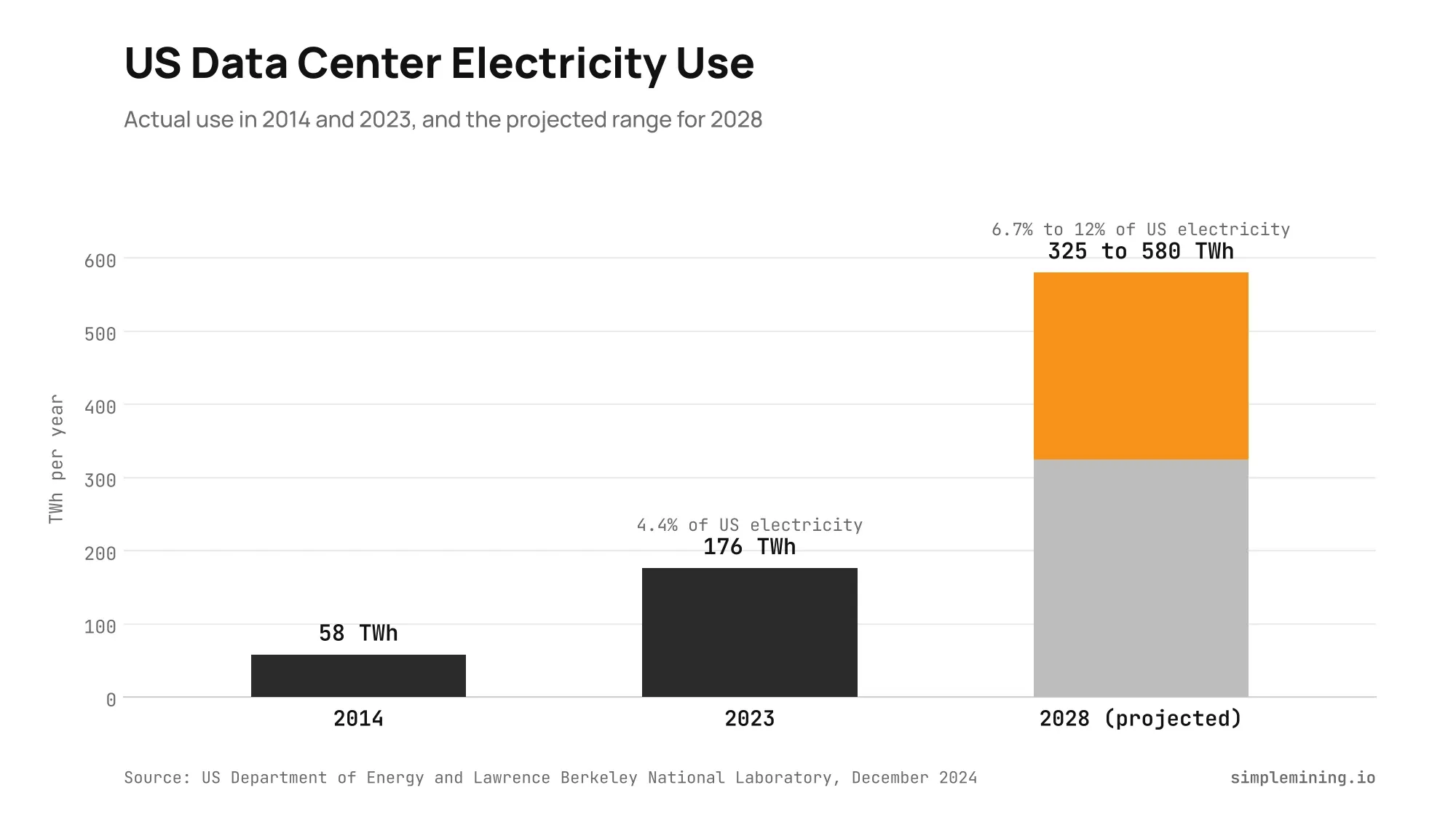
Whether data centers are a good investment, AI data centers included, depends on your goal: income, growth, or owning a real asset. The demand case is real, and so are the risks. Data centers used about 4.4% of US electricity in 2023 (176 TWh), and DOE's Lawrence Berkeley National Laboratory report projects 6.7% to 12% by 2028.
AI training and inference, cloud migration, and streaming and enterprise data drive that demand. A data center investment that suits an income investor may not suit a growth investor, and neither may suit someone who wants to own a physical asset.
- Upside: demand from AI and cloud tenants, long leases, and scarce sites with secured power.
- Watch out: high valuations, rising rates, heavy spending, and tenant concentration, all covered in the risks section below.
7 Ways to Invest in Data Centers
The seven ways to invest in data centers are data center REITs, operator stocks, supplier stocks, ETFs, private funds and non-traded REITs, direct real estate, and hosted compute hardware. Public shares sit at the liquid end with no control, and direct sites sit at the other end with the most control. The companies and funds named in this article are examples of what each category holds, not recommendations.
1. Data Center REITs
A REIT, or real estate investment trust, is a company that owns or operates income-producing real estate, and it must pay out at least 90% of its taxable income to shareholders, according to Nareit's definition of a REIT. Data center REITs own buildings and lease space, power, and connectivity to tenants. Listed data center REITs trade on stock exchanges. This route suits income-focused investors who want to sell when they choose.
2. Data Center Operator Stocks
Data center stocks in this group are shares of companies that run data center capacity and rent it out, including AI cloud providers that rent out GPU computing. CoreWeave, an AI cloud provider, priced its IPO at $40 a share on March 27, 2025 and listed on the Nasdaq as CRWV. This route suits growth-focused investors who can live with sharp swings in share price.
3. Supplier Stocks for Chips, Power, and Cooling
Supplier stocks are shares of companies that make the chips, networking gear, power equipment, and cooling systems that go inside data centers. Their sales rise and fall with data center construction budgets, not with rent. This route suits investors who want exposure to the build-out without owning property.
4. Data Center ETFs
An ETF, or exchange-traded fund, is a fund that trades like a single stock but holds a basket of companies. A data center ETF spreads your money across REITs, operators, and related firms in one trade. This route suits investors who want the theme without picking single companies.
5. Private Funds and Non-Traded REITs
Data center private equity funds and non-traded REITs pool investor money to own data centers outside the stock market. Blackstone funds, including Blackstone Real Estate Income Trust, a non-traded REIT, completed the purchase of data center operator QTS on August 31, 2021, in a deal worth about $10 billion including debt. Private funds tend to admit only accredited investors, and non-traded REITs are registered with the SEC but don't trade on an exchange. This route suits institutions and wealthy individuals who can lock up money for years.
6. Direct Data Center Real Estate
Data center real estate investment at the property level means owning, leasing, or co-developing the land and buildings yourself. Many projects start from shovel-ready land, a site where power, permits, and other major approvals are in place so construction can start. This route suits institutions and capital partners with large sums and long holding periods.
7. Hosted Compute Hardware
Hosted compute hardware means you own the machines while a host runs the building, power, and cooling. Bitcoin miners are the working example: an owner buys ASIC miners, machines built for one task, and pays a host to run them in a professional facility. This route suits individuals who want to own a real, working asset without owning a building.
Stocks vs. REITs vs. Direct Ownership Compared
Stocks and REITs give you liquidity and no control, while direct ownership gives you control and ties up your money. Deciding how to invest in data centers comes down to how much liquidity you will give up for that control.
The table compares the seven routes on liquidity, control, capital needed, returns, and main risk.
| Route | Liquidity | Control | Capital | Returns | Main Risk |
|---|---|---|---|---|---|
| REITs | High | None | Low | Dividends, price | Rates, valuation |
| Operator stocks | High | None | Low | Share price | Valuation |
| Supplier stocks | High | None | Low | Share price | Build cycles |
| ETFs | High | None | Low | Price, dividends | Mixed holdings |
| Private funds and non-traded REITs | Low | Low | High | Dividends | Lockups, fees |
| Direct real estate | Low | High | High | Rent | Power, permits |
| Hosted hardware | Medium | Machines | Medium | Mining revenue | Bitcoin price |
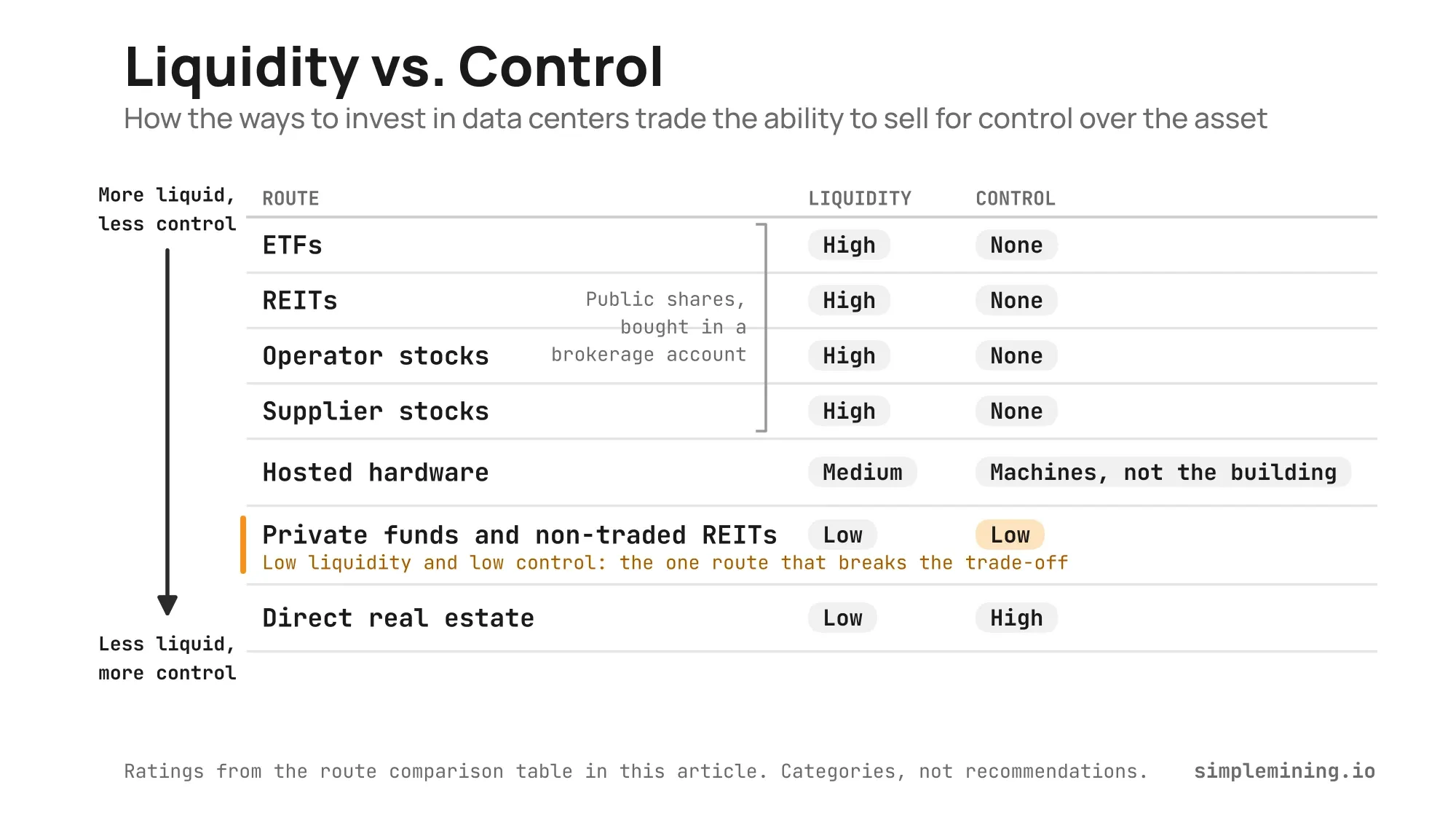
As a rule of thumb, REITs match income goals, stocks and ETFs match growth goals, private funds and direct sites match institutional capital, and hosted hardware matches owning a machine without owning a building.
Which Companies Are Data Center REITs?
Equinix, Digital Realty, and American Tower are three US-listed REITs that own data centers. Two terms explain how they earn data center rent: colocation, where many tenants rent space, power, and cooling in a shared building, and interconnection, where tenants pay to link their networks to each other inside the facility.
Equinix (EQIX)
Equinix (Nasdaq: EQIX) operates as a REIT and runs data centers in dozens of countries. What sets it apart is interconnection: networks, cloud providers, and enterprises meet inside its buildings to exchange traffic. Its tenants pay for space, power, and the connections between them.
Digital Realty (DLR)
Digital Realty (NYSE: DLR) operates as a REIT, and its portfolio spans more than 300 data centers in over 30 countries. What sets it apart is the range of its leases, from a single cabinet to very large blocks of space and power for cloud providers and other big tenants.
American Tower (AMT)
American Tower is a cell tower REIT first, and it added US data centers when it completed its acquisition of CoreSite on December 28, 2021. What sets it apart is the mix: data centers made up about 10% of its total revenue in 2025, per its annual report, so they are one piece of a broader digital infrastructure portfolio.
Is There a Data Center ETF?
Yes. Data center ETFs hold a basket of data center REITs and related digital infrastructure companies, and some also hold cell tower companies. Read the holdings before you assume a fund gives you pure data center exposure.
The Global X Data Center & Digital Infrastructure ETF (DTCR) tracks an index that also holds cell tower companies, and American Tower is one of its largest positions alongside Digital Realty and Equinix. The Pacer Data & Infrastructure Real Estate ETF (SRVR) tracks companies earning revenue from data and infrastructure real estate. Both show how funds in this category are built. Holdings and fees change, so check each fund's current page before you rely on a label.
How to Invest in Data Center Real Estate
Investing in data centers at the property level takes five steps: set capital and a holding period, choose a deal structure, verify power, confirm permits and fiber, and line up a tenant. AI infrastructure becomes investable when four things are in place: secured power, approved permits, fiber, and a long-term tenant. The steps below are written for institutions and capital partners.
1. Set Capital and Holding Period
Decide how much capital you can commit and how long you can hold it. Data center real estate ties up money for years, and an exit depends on finding a buyer or a partner. Decide early whether you want rental income from a finished building or development upside from a site that still has to be built.
2. Choose a Lease, Joint Venture, or Acquisition
The deal structure sets how much risk and control you take on.
- Lease: you own the site and lease it to an operator or tenant, often on a triple-net lease, where the tenant pays taxes, insurance, and maintenance.
- Joint venture: you share ownership, cost, and risk with an operator that builds and runs the site.
- Acquisition: you buy the site or facility outright and take on all of its risk and control.
3. Verify Secured Power and Grid Interconnect
Ask for proof that power is secured, not applied for. A grid interconnect is an approved connection to the utility grid, and the proof is a signed agreement with the utility, not a place in its queue. At any site, we look at power first: how many megawatts are committed, when they energize, and who pays for the substation.
4. Confirm Permits, Fiber, and Environmental Approvals
Check every approval before you commit capital, because a missing one can stall a project.
- Zoning that allows a data center
- Building permits
- Environmental review and clearance
- Fiber routes to the site
- Water and cooling approvals where the design needs them
5. Line Up a Long-Term Tenant
A long lease with an AI company or hyperscaler turns a site into a stable, income-producing asset. Check the tenant's credit and the lease length before you count on the rent. A site without a tenant is a development bet, not an income property.
Why Power Decides Which Data Centers Get Built
Power, not demand, is the constraint on which data centers get built. US data center electricity use rose from 58 TWh in 2014 to 176 TWh in 2023, and DOE projects a larger share of US electricity by 2028. Utility interconnection and permitting can take years, so a site with secured power is scarce.
That scarcity is why Bitcoin miners matter to this market. Miners already hold large power sites, and some now host AI tenants on that power. Bitcoin miner Core Scientific signed 12-year contracts in June 2024 to provide about 200 MW of infrastructure to host CoreWeave's high-performance computing. TFTC's write-up of Morgan Stanley research on Bitcoin miners and data center growth looks at the same overlap between mining sites and data center demand.
How Bitcoin Miners Fit Into Data Center Investing
Bitcoin miners fit into data center investing in two ways: some public miners now host AI workloads on their power sites, and individuals can own a mining machine inside a professional data center. Some crypto miners are investing in AI by turning part of their power capacity over to AI and high-performance computing tenants, as Core Scientific did with its CoreWeave contracts. Shares of these miners move with Bitcoin's price as well as with their AI contracts, so one stock carries two exposures.
The smallest direct route is owning a machine inside a professional data center through Bitcoin miner hosting. You own the hardware, the host runs the building, and rewards go to a wallet you control from a pool you pick. Simple Mining charges a hosting fee of $0.065 to $0.08 per kWh, and Precision Billing bills only for the hours a machine is hashing.
The Pause Period lets a client suspend mining without losing the slot, and Simple Mining's sites run at 95% average uptime. Simple Mining hosts only machines bought from Simple Mining, so clients buy Bitcoin miners from our inventory.
The limits are real. Revenue moves with Bitcoin's price, network difficulty, and hashprice, the revenue a terahash earns per day. Hardware ages as newer, more efficient machines join the network. The hosting fee is owed for every hour the machine hashes, whatever Bitcoin does that day. Run your own numbers in our Bitcoin mining calculator before you commit to hardware.
Data Center Investment Risks to Watch
The main data center investment risks are valuation, interest rates, heavy capital spending, tenant concentration, hardware obsolescence, overbuilding, and illiquidity in private deals. Each one hits some routes harder than others.
Valuation Risk
High expectations for AI demand can be priced into data center stocks and REITs before the revenue arrives. If growth slows or earnings miss, share prices can fall hard.
Interest Rate Sensitivity
REITs and developers carry debt, and REITs compete with bonds for income investors. Rising rates raise borrowing costs and can push share prices down.
Heavy Capital Spending
Capex, short for capital expenditure, is money spent on buildings and equipment. AI data centers need dense power and liquid cooling, so building or retrofitting one takes large sums and strong execution. Cost overruns land on owners and shareholders.
Tenant Concentration
A handful of hyperscalers and AI companies account for much of data center demand. Losing one large tenant can empty a building or cut a REIT's rent.
Hardware Obsolescence
Chips, servers, and mining machines lose value faster than buildings as newer generations arrive. Investments tied to hardware, from AI cloud providers to hosted miners, feel that aging first.
Overbuilding
If new capacity outpaces demand, rents and occupancy fall. Cheap money and hype can push developers to build ahead of real tenants.
Illiquidity in Private Deals
Private funds and non-traded REITs can lock up money for years. The SEC's investor guide to REITs warns that non-traded REITs are illiquid, tend to carry high up-front fees, and can be hard to value.
FAQs About Investing in Data Centers
Can you invest in data centers with a small amount of money?
Yes. Data center REITs, operator stocks, and ETFs trade on stock exchanges like any other stock, so a brokerage account is all you need to start. Private funds and direct real estate are the routes that call for large sums.
Can investors buy AI data centers?
Yes. Institutions buy AI data centers through leases, joint ventures, and acquisitions, often with an operator as a partner. Individuals reach the space through public markets or by owning hardware inside a facility.
What is powered land in data center investing?
Powered land is a site with secured utility power capacity, ready for a data center to be built on it. Developers value it because power is the slowest piece of a data center project to secure.
Are Bitcoin mining companies a way to invest in data centers?
Some are. Public Bitcoin miners own large power sites, and some now host AI workloads; Core Scientific signed 12-year contracts in June 2024 to provide about 200 MW of infrastructure to host CoreWeave's high-performance computing. Their shares still move with Bitcoin's price, so they mix mining exposure with data center exposure.
Can non-accredited investors buy into private data center deals?
Often not. Private funds tend to admit only accredited investors, and the SEC's two financial tests are net worth over $1 million excluding a primary residence, or income over $200,000 ($300,000 with a spouse or partner) in each of the prior two years with the same expected this year. Public REITs, ETFs, and SEC-registered non-traded REITs are the usual routes for everyone else. The SEC warns that non-traded REITs are illiquid, tend to carry high up-front fees, and can be hard to value.
Is owning a data center REIT the same as owning a data center?
No. A REIT shareholder owns shares of the company, not the buildings. You don't control leases, tenants, or what the company builds next, and the share price can move apart from the value of the property.
Choose Your Data Center Investment Path
The right data center investment path depends on whether you want income, growth, or ownership of a real asset.
- REITs: dividends and liquidity.
- Stocks and ETFs: growth exposure that trades like any other stock.
- Private funds and direct sites: institutions with large sums and long holding periods.
- Hosted hardware: owning a machine without owning a building.
To see how hosted hardware works before you own any, try hosting with a 7-day free trial on an Antminer S21+ at 235 TH/s.
This article is general information, not investment advice.